
Crowley County VINELink Coverage
Colorado VINE, accessed through VINELink, is the statewide custody-change notification channel. Research sources describe it as free and available for custody status and criminal case information. Larimer County's statewide COVINE explanation says the toll-free service is available 24 hours a day in English and Spanish and provides custody-status updates for jail inmates under supervision in participating Colorado county jails.
The Crowley research did not locate a Crowley-specific VINE participation page. That means the safe wording is careful: Colorado VINE is the statewide channel to check when a Crowley County jail detainee or CDOC inmate may be in a participating feed. Do not assume it has every Crowley local jail release, every prison discharge, or every older release record.
Colorado VINE is useful because Crowley County has three different release lanes. The local jail lane runs through the Crowley County Sheriff's Office and Crowley Combined Court. The state-prison lane runs through CDOC for Arkansas Valley Correctional Facility and Crowley County Correctional Facility. Federal and ICE paths are separate and are not covered by VINELink.
The practical use is timing. VINE can be checked before release, during active custody, or soon after a custody change when the feed still exposes the result. After the record ages out or if the source never participated, the durable proof shifts to sheriff records, CDOC records, court records, BOP, USMS, or ICE depending on the path.
Search Crowley County VINELink
A VINELink search is a one-person custody-status check. It is not the same as a Crowley County release list. If the person has already been released, the result may show a released status if the source feed still exposes it. If no result appears, the person may be outside the feed, indexed under another name, in a nonparticipating source, held federally, or only visible through court or agency records.
- Open Colorado VINE or call 1-888-263-8463.
- Select the offender or custody search option.
- Search by last name and first initial or first name, or use any accepted identifier available in the system.
- If the location is unclear, search all Colorado facilities rather than assuming a Crowley County source.
- Open the matching result and compare identifiers before relying on the status.
- Read whether the person is in custody, released, transferred, escaped, deceased, or in another source-feed status.
- Confirm exact release date, release reason, or transfer destination with the sheriff, CDOC, or court when needed.
For a full search path after a person drops off a roster, use the Crowley County released inmates page. VINE is one channel in that chain, not the whole record system.
When there are multiple possible matches, slow down before registering. Crowley County has the local jail function, AVCF, and CCCF, and names can repeat across a statewide system. Match the facility, agency, spelling, and any available identifier before treating the result as the right person.
Use broader facility selection when the custody source is unclear. A person arrested in Crowley County might move to CDOC after sentencing, while a person held at a Crowley County prison might have no local Crowley court case. Searching all Colorado facilities can prevent a false no-result caused by choosing the wrong agency first.
Crowley VINELink Release Fields
VINE display labels can vary by source feed. The research supports describing the common field types, not promising an exact Crowley-specific screen. A released result is useful custody-status evidence, but the release record itself still comes from the sheriff, CDOC, or court.
The Colorado VINE search page is the relevant source for the statewide VINELink lookup.
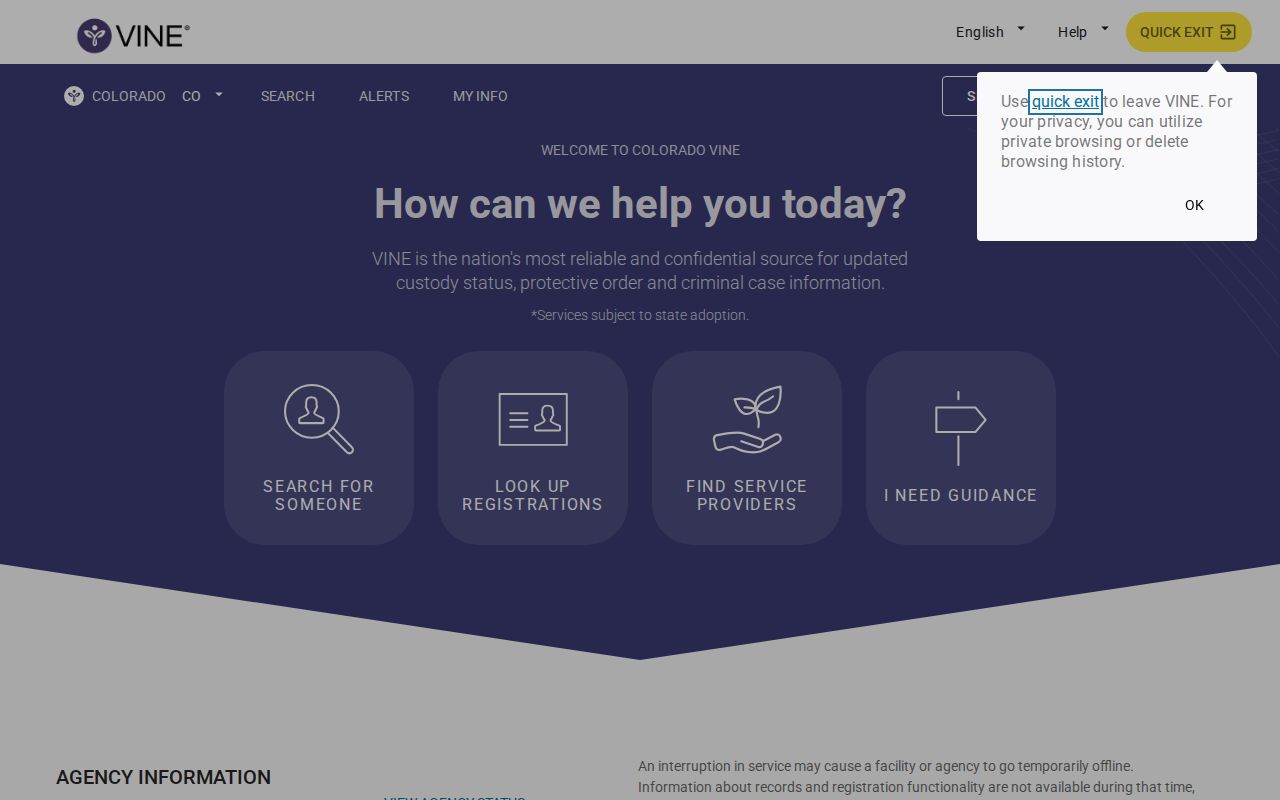
The search page should be used for status checks and alert registration, then paired with the official record source for exact release facts.
| VINELink field | What it can show | How to verify |
|---|---|---|
| Custody status | In custody, released, transferred, escaped, deceased, or another feed status. | Call the source agency or request the release record. |
| Facility or agency | The jail, prison, or source listed by the feed. | Match it to sheriff, CDOC, court, or another agency. |
| Name or identifier | The indexed name or accepted identifier used for matching. | Compare date of birth or agency ID when available. |
| Release or custody-change status | A release, transfer, or other status change when the feed makes it available. | Confirm exact date, time, and reason with the custodian. |
| Notification options | Phone, email, text, TTY, in-app, or other methods where offered. | Complete registration and retain any PIN required for calls. |
Crowley County Release Alerts
Colorado VINE is strongest when the person is still in custody and the user needs a custody-change alert. Douglas County's Colorado VINE explanation supplies the clearest public workflow located in the research: online users choose Colorado, search and register for offenders, choose all facilities or the relevant sheriff, enter the last name and at least the first letter of the first name, open details, and select a notification method. Phone users call the toll-free number, search by name, hear current status, and choose registration for updates.
- Open the matching person record from the VINE search result.
- Select the register or notification option if it is available.
- Choose phone, email, text, TTY, in-app, or another supported method.
- Enter the contact details requested by the system.
- Create or provide the PIN required for phone notifications when prompted.
- Keep the PIN because automated calls may require it to confirm receipt.
If the person is not currently in custody or no longer exists in the feed, registration may not be available. In that case, use the Crowley County Sheriff's Office for local jail records, CDOC for prison records, or Crowley Combined Court for disposition and probation records.
Phone alerts deserve extra care. The PIN is not a password for public records. It is used so the automated call system can confirm that the notification was received. Keep it available, especially if several custody-change calls may come from the same record.
Crowley VINE Fallback Layer
Crowley County did not surface an official browser-readable 24-hour or 72-hour release roster in the research. That makes VINE more important as a notification layer, but it also makes its limits more important. VINE can show custody-status changes from participating feeds. It does not replace the public record of official action, and it does not prove why a person was released.
For a local jail release, the fallback is sheriff records, the sheriff app if available, Colorado VINE, and Crowley Combined Court. For a CDOC release from AVCF or CCCF, the fallback is CDOC Offender Search, CDOC records, the parole board calendar when a hearing is involved, and CDOC parole or reentry contacts. For a federal move, use BOP or USMS. For an ICE transfer or immigration hold, use ICE ODLS if the record points that way.
This fallback chain is especially important in Crowley County because no official browser-readable 24-hour or 72-hour release roster was located. VINE can help fill the notification gap, but it should be paired with the release record, court disposition, or CDOC offender record when the exact status matters.
Local news or social posts may mention jail activity counts, but those posts are not a person-level custody source. They can point to public interest in a release event. They should not replace VINE, the Sheriff's Office, CDOC, or the court when the question is whether one named person was released.
Limit: VINELink is a custody notification tool, not a certified release record, and no result is not proof that custody never occurred.
Crowley County Registry Limits
Colorado's main public offender registry for released people is the CBI sex offender registry. That registry covers a specific legal status. It is not a list of all released inmates, all jail releases, or all people on parole or probation. CBI search snippets state that the registry is updated hourly and that not all sex offender information is available online.
CBI's public search agreement snippet says misdemeanor-only sex-offense convictions and juveniles adjudicated for sex crimes are not posted in the public search. It also says local police, the county sheriff, or CBI may be contacted for a complete list. Use that source only when registration status is relevant. For most Crowley County release checks, use the sheriff, court, CDOC, VINE, BOP, USMS, or ICE path that matches the custody source.
- VINE
- A custody-status and notification system for participating feeds.
- Registry
- A legal-status database for qualifying registered offenders, not a release roster.
- Release record
- The agency or court record showing release from custody, transfer, parole, discharge, or disposition.
Crowley VINELink Confirmation
VINELink does not cover every custody system. BOP's Inmate Locator covers federal inmates from 1982 to present and can show Released or Not in BOP Custody. BOP also cautions that no BOP location does not rule out custody in another justice system or supervision. USMS covers federal pretrial custody until acquittal, conviction, or delivery to BOP. ICE ODLS is a separate locator and should be used only when an ICE hold, detainer, or transfer is part of the known facts.
For Crowley County local jail releases, call the Sheriff's Office and check court records if VINE is silent or incomplete. For prison releases, use CDOC Offender Search and CDOC records. For release alerts, VINE is a good first tool while custody is active. For exact release date, release type, transfer destination, or supervision status, the source agency record controls.
When the VINE record and another source disagree, treat the disagreement as a prompt to verify, not as proof that one source is false. Custody data can update at different speeds. A court order can exist before jail processing is complete, and CDOC can show a prison status that does not answer a county jail question.
Note: VINE can help alert a custody change, but court and agency records explain the legal reason behind that change.