
Crowley County Projected Release
A projected release date is a planning date, not always the date a person walks out. In Colorado prison records, the better terms are often PED and MRD. PED means parole eligibility date. MRD means mandatory release date. CDOC Time Comp says PED is the first date an offender is eligible to be released to parole, while MRD is the maximum incarceration date if discretionary parole is not granted by the parole board.
Actual release can differ from both terms. A parole plan, board action, detainer, transfer, court credit correction, or another agency hold can change what happens on the ground. For a Crowley County local jail sentence, public sources do not give a county-specific good-time formula or weekend-release rule. The Sheriff's Office or Crowley Combined Court must confirm local jail release date and reason.
Scheduled vs actual: PED is eligibility, MRD is a maximum prison-term date, and an actual release is confirmed by the releasing agency record.
Find Crowley County Release Date
Start with the facility. Arkansas Valley Correctional Facility and Crowley County Correctional Facility are CDOC facilities, so their release-date terms come from the statewide CDOC system. The Crowley County Sheriff's Office / Crowley County Jail function is local, so a release time can depend on court orders, bond, sentence credit, transfer, or a hold.
- Identify whether the person is held by the Crowley County Sheriff's Office, CDOC, BOP, USMS, or ICE.
- For a CDOC prisoner, search the CDOC Offender Search by DOC number when possible.
- Read the person record for parole eligibility, mandatory release, release, parole, or discharge fields that appear.
- Use the CDOC Time Comp page to understand PED, MRD, good time, earned time, and mittimus terms.
- For a Crowley local jail sentence, contact the Sheriff's Office and check Crowley Combined Court for sentence, credit, bond, warrant, or disposition entries.
- Register through VINELink Inmate Search if the person is still in a participating custody feed and release or transfer alerts are needed.
For a named-person search that is broader than release dates, use the Crowley County released inmates search path. A person who was transferred from the county jail to CDOC should move out of the local jail lane and into the CDOC lane.
The same routing rule applies when the person was housed in Crowley County but sentenced somewhere else. A CDOC prisoner at AVCF or CCCF may have a mittimus from another Colorado court, so Crowley Combined Court may have no sentence file for that person. In that case, CDOC is the first date source, and the sentencing court is the source for mittimus or credit questions.
When the person has only a pending local case, look for release authority in the court and jail record rather than in CDOC time computation. A bond decision, personal-recognizance order, warrant hold, or dismissal can change custody quickly. Those events are release reasons, but they are not projected prison-release dates.
Crowley County PED and MRD
CDOC's terms are critical in Crowley County because two prison facilities sit inside the county. A person housed at AVCF or CCCF may have been sentenced in Crowley County, but that is not required. The CDOC record is statewide. Search by DOC number when possible because CDOC Search Tips says DOC number is the primary way the department identifies offenders.
CDOC says the court mittimus starts the sentence calculation. The mittimus is the sentencing document issued by the court. It outlines the sentence terms, and CDOC says it cannot modify the sentence or change the mittimus. Only the court can do that. Time and Release Operations calculates PED and MRD after CDOC receives the mittimus and applies the sentence terms and statutes.
If the public offender record seems inconsistent with the sentence, the correction path depends on the issue. A wrong credit award may need the sentencing court. A calculation question may need CDOC Time and Release Operations. A parole timing question may need the parole board, parole office, or case manager. The public search is a pointer to the right record holder.
The CDOC Time Comp source shows how Colorado defines these release-date terms.
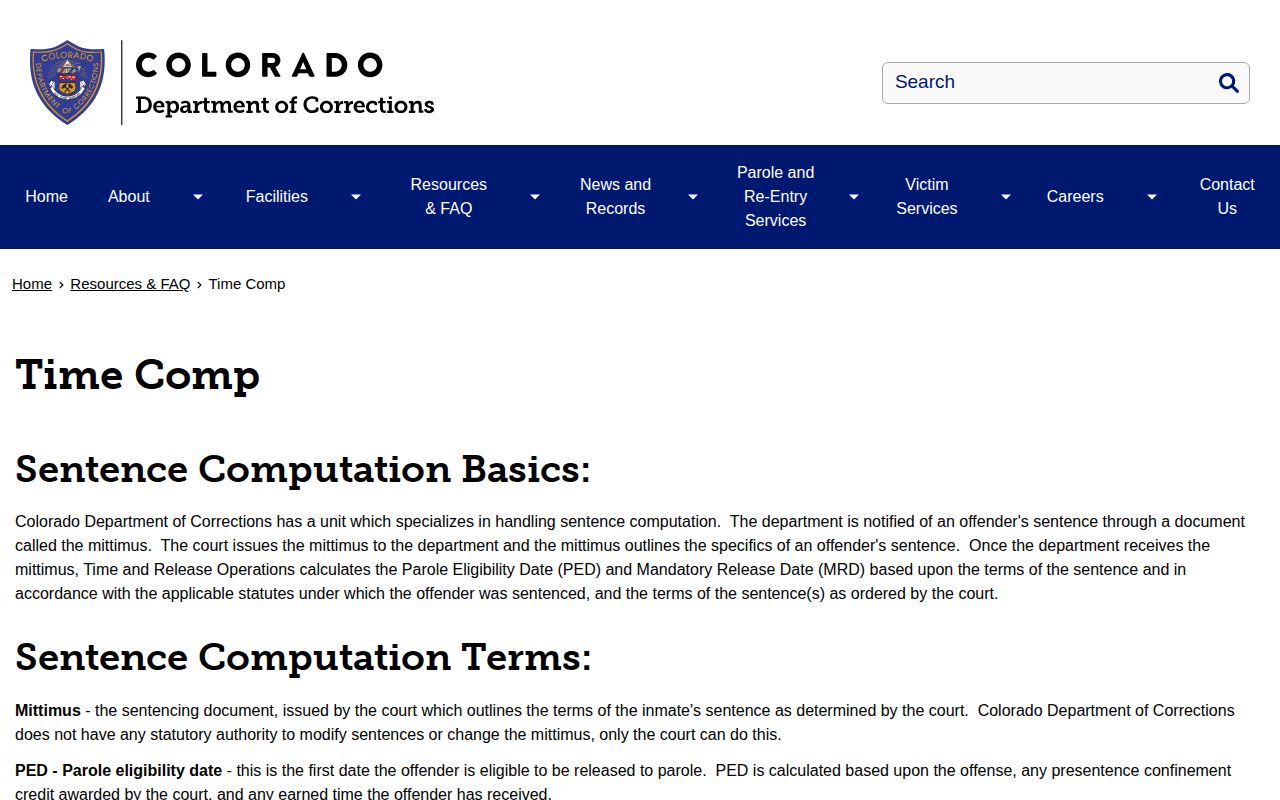
Use it to read the vocabulary, then confirm the person's actual date through CDOC records or the court that issued the mittimus.
| Term | What it means | What it does not prove |
|---|---|---|
| PED | First date the offender is eligible to be released to parole. | It is not proof that release was granted that day. |
| MRD | Maximum incarceration date if discretionary parole is not granted. | It may not be the facility exit date if holds or transfer issues exist. |
| Release, parole, or discharge date | A date field tied to a custody or supervision event. | It should still be confirmed when precision matters. |
Crowley County Earned Time
Good time and earned time are not the same thing. CDOC Time Comp says good time is a portion of the maximum sentence, either 50% or 25% as determined by the statutory requirements of the conviction, credited to establish parole eligibility. Earned time is a monthly award that may bring PED and MRD closer. The amount depends on law and documented progress.
C.R.S. 17-22.5-405 provides the earned-time framework, including up to 10 days per month in general and up to 12 days per month for some lower-level felony or drug felony sentences. The parole eligibility statute, C.R.S. 17-22.5-403, is the key release-date law for many determinate Colorado felony sentences.
Do not reduce Colorado release-date work to a single percentage. Many class 2-6 felony and level 1-4 drug felony sentences use a 50% parole-eligibility framework, less earned time. Some serious violent offenses committed before January 1, 2025 use 75% rules. Covered serious violent offenses committed on or after January 1, 2025 use an 85% parole-eligibility threshold, and earned time cannot reduce the required service below that threshold.
That is why the conviction date and statute matter. Two people housed in Crowley County can have very different parole eligibility even if they are in the same facility. The mittimus, offense date, earned-time eligibility, sentence structure, and parole board action control the date, not the county where the prison bed is located.
Note: The correct percentage depends on offense date, conviction statute, sentence structure, mittimus, credit, earned-time eligibility, and parole board action.
Crowley County Date Changes
A changed projected release date is not always an error. It may be the result of a credit change, disciplinary issue, parole decision, or a hold from another agency. In Crowley County, it is also easy to confuse a local jail release with a CDOC prison release because AVCF and CCCF are in the county but are not county jail facilities.
| Change factor | How it can affect release | Where to confirm |
|---|---|---|
| Earned time awarded or withheld | May move PED or MRD closer or leave the date unchanged. | CDOC Time and Release Operations or CDOC records |
| Presentence confinement credit | Can change the sentence computation if corrected by the court. | Sentencing court and mittimus record |
| Consecutive or concurrent sentences | Can change how terms are combined or served. | CDOC records and court sentence documents |
| Parole board action | Can defer release even after PED. | Parole board calendar, CDOC status, parole office |
| Detainer or hold | May turn a release from one system into transfer to another. | Sheriff, CDOC, BOP, USMS, ICE, or court source listed on the record |
Crowley Jail Release Timing
County jail release dates are less formulaic in the public sources than CDOC prison dates. A pretrial detainee has no computed prison release date. Release may depend on bond, personal recognizance, dismissal, a court order, time served, warrant clearance, or another agency hold. A short jail sentence may include court-awarded credit and a sentence start date, but no Crowley-specific jail good-time policy was located.
Ask the Crowley County Sheriff's Office for the official action release record when the person was held in the local jail function. The useful fields are release date and time, release type or reason, booking number, charge or case number, bond status, and transfer or hold status. Check Crowley Combined Court when the release followed a hearing, sentence, probation order, warrant recall, or case disposition.
If the jail release is tied to a pending case, the court record may explain why the date changed. A bond order can allow release before the case ends. A warrant recall can remove the hold that kept the person in custody. A mittimus can move the person from a local jail sentence into the CDOC calculation path. Those are different release events, so ask for the document that matches the event.
A transfer to CDOC changes the search. After sentencing or transfer to AVCF, CCCF, or another state facility, the next date source is CDOC. A federal transfer changes it again. BOP can show federal release date and location fields, while USMS covers federal prisoners from court-ordered custody until acquittal, conviction, or delivery to BOP. ICE ODLS is a separate civil immigration detention locator when the release record points that way.
Confirm Crowley Release Date
CDOC's offender-search disclaimer says database information may sometimes be inaccurate and instructs users to contact CDOC to confirm information. Treat a public search result as a guide to the right agency, not the final certified answer. When a date must be exact, request the record from the office that controls it.
For CDOC records, CDOC says inmate departmental record requests go to doc_open_records@state.co.us. The request should include the person's name, DOC number if known, date of birth if known, and the detailed record requested. For court records, the Colorado Judicial Branch Access Guide says specific case records can be requested through the online records request form or by contacting the court location. For local jail records, contact the Crowley County Sheriff's Office and ask for jail, booking, or records staff.
Use VINE for alerts while the person is still in a participating feed. Use the source record for proof.
For older releases, expect some public tools to lose detail. VINE is not a permanent archive, and local jail views often focus on current custody. CDOC and court records are more durable because they tie the date to the sentence, parole action, discharge, disposition, or official release event.
If the record shows release but the person is not reachable, do not assume the release was to the community. The next event may have been parole, community corrections, a transfer, a detainer pickup, or another agency's custody. Ask the releasing agency for transfer or hold status when that distinction matters.